
Blog
Deep Anterior Neuromyofascia: The Hidden Chain Behind Your Pain

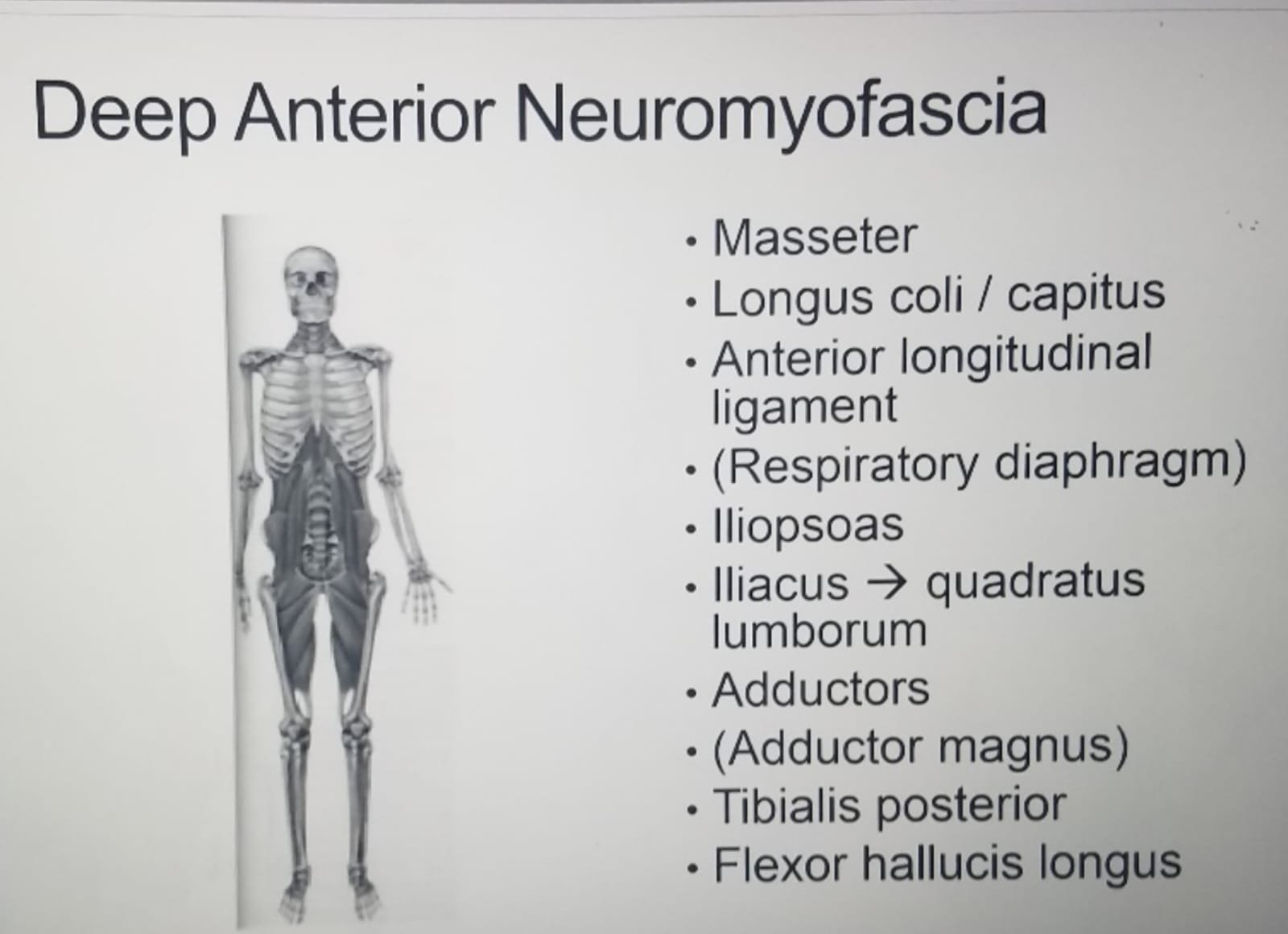
Most people think of pain as a local problem — a sore knee, a stiff neck, a tight lower back. But the human body does not work in isolated parts. It works as a connected system of muscles, nerves, and fascia that run in continuous lines from head to toe. One of the most important and least understood of these lines is the Deep Anterior Neuromyofascial chain — a network of deep structures running along the front of the body that influences posture, movement, breathing, and pain in ways most people never realize.Understanding this chain is essential to understanding why pain in one area so often shows up as symptoms somewhere completely different.What is the Deep Anterior Neuromyofascial Chain?The deep anterior chain runs from the jaw all the way down to the sole of the foot — connecting structures that are rarely treated together, yet function as a single integrated system. When any one structure in this chain becomes restricted, tight, or dysfunctional, the tension travels up and down the line — creating pain, weakness, and compensation patterns far from the original source.The key structures in this chain include the masseter, the longus coli and capitus, the anterior longitudinal ligament, the respiratory diaphragm, the iliopsoas, the iliacus into the quadratus lumborum, the adductors including the adductor magnus, the tibialis posterior, and the flexor hallucis longus.Breaking Down Each StructureThe masseter is the large jaw muscle responsible for chewing. When chronically tight, it contributes to jaw pain, TMJ dysfunction, headaches, and tension that travels down into the neck and upper cervical spine.The longus coli and longus capitus are deep cervical muscles that run along the front of the cervical spine. Restriction here creates forward head posture, neck stiffness, and difficulty rotating the head — and directly loads the facet joints of the upper spine.The anterior longitudinal ligament runs the full length of the spine along its front surface. It plays a critical role in spinal stability and posture. When the structures attached to it become restricted, it limits spinal extension and contributes to chronic postural dysfunction.The respiratory diaphragm is not just a breathing muscle — it is a core stability structure that attaches directly to the lumbar spine. Restricted diaphragm function affects breathing capacity, intra-abdominal pressure, and lower back stability simultaneously.The iliopsoas is arguably the most important muscle in the entire chain. It connects the lumbar spine to the femur and is the primary hip flexor. When tight — which is extremely common in people who sit for long hours — it creates a constant anterior pull on the lumbar spine, compressing the facet joints and driving chronic low back pain.The iliacus works alongside the iliopsoas and feeds directly into the quadratus lumborum — a deep muscle of the lower back that is a frequent source of acute and chronic back pain. Restriction in the iliacus amplifies tension in the quadratus lumborum, making lower back pain significantly worse.The adductors, including the adductor magnus, run along the inner thigh and connect the pelvis to the femur. Tight adductors create pelvic instability, groin pain, and altered hip mechanics — all of which load the lower back and knee. The adductor magnus in particular has a direct fascial connection into the posterior chain, linking the front and back of the body.The tibialis posterior runs deep in the lower leg behind the tibia and plays a critical role in arch support and ankle stability. Restriction here contributes to flat feet, shin splints, plantar fasciitis, and altered gait mechanics that travel all the way up the kinetic chain to the knee, hip, and back.The flexor hallucis longus runs from the back of the lower leg to the big toe. It is essential for push-off during walking and running. When restricted, it contributes to big toe stiffness, plantar fasciitis, achilles tendon loading, and reduced propulsion — changing the way force travels through the entire lower body with every step.Why This Chain Matters for Your RecoveryWhen you treat back pain only at the back, or knee pain only at the knee, you are missing the bigger picture. The deep anterior chain connects your jaw to your foot — and restriction anywhere along it creates compensation and pain somewhere else along it.This is why REGENV focuses on mobilizing the key structures of this chain — the hip flexors, adductors, lower leg, and foot — rather than treating symptoms in isolation. By restoring length, mobility, and circulation to these deep anterior structures, REGENV helps the entire system move and function the way it was designed to.Real recovery begins when you stop chasing the pain and start addressing the chain.